
Rotary Friendship Exchange (RFE) in New Mexico
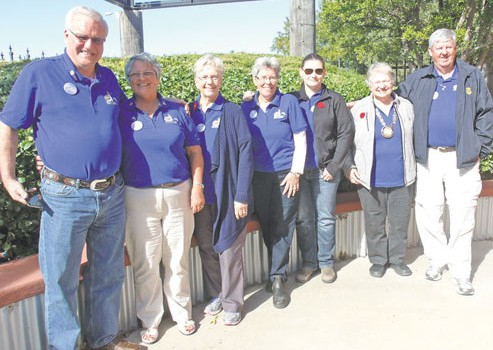
A group of friendly invaders from Canada’s Atlantic coast were in Roswell earlier this week as part of a Rotary exchange. The Rotarians were from District 7820 Atlantic Canada, which includes clubs from the provinces of Newfoundland-Labrador, Prince Edward Island and Nova Scotia and the French island Les Iles de Saint Pierre et Miquelon.
From left: Tom and Shirley McCaughley, Newfoundland-Labrador; Marg Chisholm, Nova Scotia; Anne Gillis, Prince Edward Island; Sonya Piercy, Newfoundland-Labrador; Frieda Burger, Nova Scotia; and Don Chisholm, Nova Scotia. (Timothy P. Howsare Photo)
The Canadians arrived in Roswell on Sunday and stayed at the homes of local Rotarians. On Monday, they all got a bird’s eye view of the area from a hot-air balloon.
On Tuesday, they breakfasted with the Sunrise Rotary Club and toured sites in around Roswell, including the New Mexico Military Institute campus and historic Lincoln.
On Wednesday, they attended the Pecos Valley Rotary Club’s weekly lunch meeting, where several gave a PowerPoint presentation on what life is like on Canada’s rocky eastern coastline.
The three provinces combined comprise a geographic area roughly the size of Montana, and it would take a total of 40 hours to drive all of the coastlines. The population is sparse, with about 1.56 million people living in all three provinces. Most of the population is concentrated in cities and towns.
The primary industries are fishing, tourism, agriculture and naval ship building.
Though the northern latitude of the provinces translates to cold winters, some of the coastlines get a warming effect from the Gulf Stream.
An interesting fact about Newfoundland-Labrador is that it is in its own time zone that is a half hour ahead of rest of Atlantic Canada.
The Daily Record asked whether this creates confusion with television broadcasting that comes from the mainland, Tom McCaughley from Newfoundland-Labrador answered yes and added things really became a mess when the premier, the counterpart to a governor in the U.S., decided the province should go on “double Daylight Saving Time.”
“The 10 o’clock news was on at 12:30,” he said. That policy has since been disbanded. Apparently the U.S. isn’t the only country with politicians who come up with kooky ideas.
The unique time zone dates back to when Newfoundland-Labrador was a sovereign nation. It was the last to join the Canadian union in 1949.
Another little-known but important fact about Nova Scotia and Newfoundland-Labrador is their role during the terrorist attacks of Sept. 11, when 55 commercial airliners where diverted from American airspace to land at airports in the Atlantic provinces.
Canadians drove to the airports to pick up the thousands of stranded passengers and brought them back to their houses or put them up in church basements.
After the meeting in Roswell, the northern neighbors headed off to Fort Stockton, Texas, to hook up with Rotarians in that city. After that, they were scheduled to return to Canada
From a story that appeared in the Roswell Daily Record