
An interview with PRIP Wilf Wilkinson - 50 years in Rotary
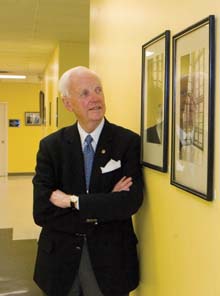
It was chance that brought Rotary Foundation Trustee Chair Wilfrid J. Wilkinson to Trenton, Ont., to start the local branch of an accounting firm in 1961. He told his wife that the family could move back to their hometown of Montreal in a year. But he and Joan fell in love with life in a small town, where Wilkinson could come home for lunch and Joan could bring their four sons to visit at the office in the afternoon. In 1962, Wilkinson was invited to join the Rotary Club of Trenton, and the family put down roots.
Fifty years later, Wilkinson Ц now a grandfather Ц is retired from a successful accounting career and has served Rotary at its highest levels. He became RI president in 2007, making him the fifth Canadian to hold that office, and the first in nearly 60 years. In July, he took over as Rotary Foundation trustee chair, stewarding the Foundation as it transitions to a new grant model under the Future Vision Plan. Susie Ma, a frequent contributor to Rotary Canada, sat down with Wilkinson at RI World Headquarters in Evanston, Ill., USA, to talk about the past, present, and future of Rotary.
ROTARY CANADA: What comes to mind as you reflect on your 50 years in Rotary?
WILKINSON: The first international convention my wife and I attended, in 1964 in Toronto. I joined Rotary because of the local things the club was doing. At the convention we saw the internationality of Rotary. We saw people from many countries in their native dress. It was very stimulating, as were the speakers. Another highlight was the opportunity to be president of my Rotary club. It happened that I became president on 1 July 1967, and it was Canada’s 100th birthday. Our Rotary club organized Canada Day celebrations because we felt part of the community and of our country. Finally, you can’t assume the RI presidency without feeling a great deal of pride, because by this time, you recognize how much good work is being done by Rotarians. It’s a dream to be given the opportunity and honour to lead such an organization.
RC: You’re wearing several pins on your lapel. What does each one mean?
WILKINSON: This is the Order of Canada [points to a silver maple leaf inset on a white snowflake]. It’s the highest civilian decoration that the country can give. I received it for my humanitarian service from the Governor General of Canada on behalf of the Queen in May 2007. For a long time, I did not wear the pin. I felt that I got the Order of Canada because of the work of so many other people. I got it because of working with many organizations around Trenton, of which Rotary was most prominent. Then someone said, “You never wear your pin. Aren’t you proud of the people who helped you get it?” So I decided to wear it more often.
I believe that every Rotarian should wear his or her lapel pin [pointing to his Rotary pin, which features a red sponsor banner], and I particularly want to encourage Rotarians to remember that they have a responsibility to share Rotary with non-Rotarians. When I was RI president, I wanted membership to increase, so I gave badges to all my district governors to give to Rotarians in their districts who sponsored a new member. I have managed to sponsor a new member every year since 1996, mostly Ц but not entirely Ц for the Rotary Club of Trenton.
I also want the public to know what Rotary is doing to combat polio [points to his End Polio Now pin] and join us and contribute to that work. I also have a bumper sticker on my car that says End Polio Now.
RC: During your presidency, Rotary’s US$100 Million Challenge was announced. The challenge later grew to $200 million. What is your response to the progress on the challenge and toward the eradication of polio?
WILKINSON: I’m very appreciative that Bill Gates joined the cause. Rotary didn’t realize how difficult a job eliminating polio would be. Gates helped energize Rotarians for the final uphill push. We still have major challenges. I came back from Nigeria in April, and it’s not easy over there, but we are making headway. The involvement in Pakistan this year is so much better, and in Nigeria too. But, unlike in India, we don’t have as many Rotarians in Pakistan and Nigeria.
RC: Tell us about your role as trustee chair of The Rotary Foundation.
WILKINSON: Trustees have three jobs. One is to raise money, the second is to invest the money carefully, and the third is to spend it wisely. On the other hand, trustees also have to have a good knowledge of the programs of the Foundation. Past presidents are very often the best fundraisers. That’s why it’s not unusual for past presidents to be asked to serve as trustees.
RC: What is your fundraising goal?
WILKINSON: It is my hope and desire that every Rotarian in the world, particularly every Rotarian in North America, would contribute something each year to the Foundation. If the average of those contributions were US$100 per member, then we would reach our goal of $120 million for the 2012-13 Rotary year [based on 1.2 million members worldwide].
RC: What else would you like to accomplish this year?
WILKINSON: My job is to make sure that every Rotary district in the world is ready to work toward our goals under Future Vision. [The areas of focus are peace and conflict prevention/resolution, disease prevention and treatment, water and sanitation, maternal and child health, basic education and literacy, and economic and community development.]
To find the most successful way to do that, weТve had a pilot for the last two years. Based on the pilot [which ends 30 June], we are preparing to train every district in the world to better utilize The Rotary Foundation. For example, under the Future Vision Plan, 50 percent of the contributions from the clubs in a district will go back to the district in three years to be spent on projects. We want to spend money on the most important areas to do the most good in a sustainable manner. It’s easy to throw money at things. The question is: Is it making a real difference?