A special mission in Liberia

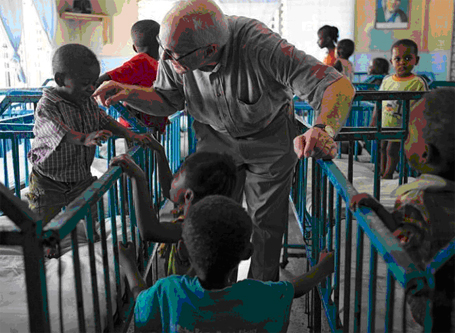
Rich Casey, president of the Los Altos Rotary AIDS Project, stands next to a bed at St. Joseph’s hospital in Monrovia, Liberia, where a woman has just given birth to a boy. Casey looks down, sees the baby receiving a dropperful of medicine, and knows that he and his fellow Rotarians have helped save a life. Without the medication – nevirapine – the baby, born to an HIV-infected mother, would have a high likelihood of also being infected, and probably would not live past the age of five. The drug, which costs US$1 per dose, helps prevent the transmission of HIV from the mother and dramatically increases the baby’s chances for a healthy childhood.
Casey understands that the Rotarians face an immense challenge in fighting HIV/AIDS in Liberia: About 5,000 Liberian women are infected annually. Intervention at any stage is critical. The Los Altos Rotary AIDS Project has been raising money to help provide lifesaving medication. But reaching out to the women, educating them about HIV prevention and treatment, and tracking their postnatal medical condition is also essential, and requires a small army of trained volunteers. One of Casey’s missions has been to find funding for that endeavor as well. In late January, he traveled to Liberia for a project that provided training to local health care workers – and that, in large part, resulted from a Rotary Foundation Global Grant awarded jointly to the Rotary clubs of Los Altos, Calif., USA, and Sinkor, Montserrado County, Liberia.
When Casey came upon that baby in Monrovia, it was his first direct experience with the treatment he and the Los Altos project committee were working to provide. “It was one of the most rewarding moments of my life,” he would tell family, friends, and club members after returning home. And he would add, with a passion that defines his personal commitment: “It outrages me that babies are born into this world with a death sentence. They didn’t do anything to deserve their fate.”
It was fate that played a crucial role in Casey’s journey from Silicon Valley to Liberia. Five years ago, he was standing in the checkout line at his local supermarket when he heard a woman behind him ask, “Excuse me – aren’t you Rich?” The woman, Mary Prochnow, hadn’t seen Casey since they were classmates in grammar school almost 40 years earlier. “How she remembered me, I’ll never know,” says Casey, who was by then in his 50s and retired from the biotech industry. Prochnow, too, has no idea why or how she recognized him: “Something just told me. Serendipity.” After catching up, they discovered that they were both raising funds through separate organizations for an identical cause: the eradication of AIDS. To each, it seemed destined that they join forces to educate and help save African mothers and children. The grim statistics were familiar to both: 33 million children and adults are infected globally; almost 70 percent live in sub-Saharan countries like Liberia.
At the time, Casey was chair of Save the Children’s HIV/AIDS Leadership Council, and Prochnow, a founding member of the Los Altos club’s pioneering task force on AIDS, was active on the club fundraising committee. “Our AIDS project needed a boost,” she says. “We’d reached a plateau when I bumped into Rich.” She wasted no time in arranging a meeting between Casey and Dushan ‘Dude’ Angius, the force behind the project. “Two days after our encounter,” Casey recalls, “I was sitting with Dude in her real estate office. That’s Mary.”
Before the meeting, Prochnow had filled Casey in on Angius’ role in founding the Los Altos Rotary AIDS Project, which aims to engage Rotarians in the fight against the disease through programs that provide education and support. At a club meeting in 1989, she explained, Angius, who was serving as club president, announced in a strong, clear voice that his son Steve was dying of AIDS. Angius and his wife, Barbara, had also learned that Steve was gay. “My son’s the greatest guy in the world,” Angius told the group. “We’re going to do what we can to keep AIDS from spreading further, and I need your help.”
“To my knowledge, it was the first time anyone had ever said the word AIDS aloud in Los Altos,” Prochnow says. Twenty-three years ago, it was not a topic for discussion in this conservative, upper-middle-class suburb. “I was overwhelmed and impressed by Dude’s courage and integrity. Here’s this man’s man, a former basketball coach, not only informing all his buddies that he had a gay son with AIDS but also that he wanted his Rotary club to take action. Dude put it to them simply: ‘Our friends will understand. If they don’t, they’re not our friends.’ There was no precedent. He took that chance at a time and place when just about nobody else would have.”
Prochnow was the first club member to rush up to the podium in support. “It was a knee-jerk reaction on my part,” she recalls. She realized that the Angius family’s tragedy could have happened to anyone. “If I did nothing, I couldn’t live with myself.”
Angius set up an AIDS task force, and 10 Rotarians met weekly over the next six months, with Mary and Dick Hasenpflug as cochairs. “We were like a crew, all of us rowing in the same direction, and we got to see the effects of our work. It was a sublime experience,” Prochnow says. The club funded a powerful 30-minute documentary, The Los Altos Story, that told how AIDS had changed the lives and perspectives of Los Altos club members. Fox-TV aired it nationally. Written and directed by former NBC news correspondent Robin Young, the documentary opens in the Angius family’s home as Steve lies in his bedroom, too weak to move, on what turns out to be the last day of his life. It won a Peabody Award, the first time that a service group had earned the recognition. Today, more than 20,000 copies of the 1990 documentary are in circulation throughout the world; with help from a $20,000 Matching Grant from the Foundation, it has been translated into seven languages. Time has not diminished its impact: The Los Altos club provides the DVDs free of charge to motivate Rotarians to fight the worldwide AIDS epidemic.
Though all of that background helped prepare Casey for his initial meeting with Angius, nothing primed him for the force of the man’s personality. Angius, though walking with a cane and losing his eyesight to macular degeneration, still embodied the soul of a warrior. He listened as Casey explained his AIDS prevention work, then leaned in and smiled: “That’s all real interesting, Rich, but if you want to get somewhere with this, you’ll have to join Rotary.”
“I’m not a joiner,” Casey replied.
“Doesn’t matter,” Angius told him. “The leaders in other countries are Rotary members, and those Rotarians won’t take you seriously unless you’re one of them. Rotary’s your way in.”
There was no use arguing with that. Casey joined the Los Altos club, and Angius approached him soon after. “My health’s declining, as you can see,” he said. “I need you to take over the project.” There was no use arguing with that either.
Casey met club member Allart Ligtenberg, who was responsible for helping to print and circulate 10,000 copies of a Nepalese translation of an educational book, HIV Health and Your Community; an estimated 100,000 adults and children in Nepal are infected. He also met past club president Marlene Cowan, who had been soliciting financial help from Bay Area corporations and arranging for club members to deliver presentations on AIDS to their boards. “The intervention drugs are in the bio-med companies, and that’s where the money is. They should be tapped on the shoulder,” she explains. Casey approached Gilead Sciences, a leading pharmaceutical company providing medicine to combat HIV/AIDS, and it has become a major funding source.
Casey and the project committee turned their focus to Liberia after studying the AIDS epidemic in Africa. They chose it as a specific target, Casey and Angius say, for several reasons: There would be no language barrier, and in a country with a relatively small population, reducing the incidence of the virus in newborns to nearly zero was a real possibility. Also, the Los Altos club would have the rare opportunity to team up with leading pediatric AIDS specialist Dr. Art Ammann and his organization, Global Strategies for HIV Prevention. Ammann is credited with the first diagnosis of pediatric AIDS. “To us,” Casey says, “Liberia is a manageable situation” – and a testing ground for their ultimate goal of eradicating AIDS globally.
But there are challenges. A social stigma surrounds AIDS: few men in Liberia agree to be tested, and women are reluctant to let others know they need assistance. To address this issue, clinics have been set up, with help from the Foundation, in hospitals like St. Joseph’s, where women can go for treatment under the cover of a broad-based medical facility. Over 3,000 people have already been tested in four clinics.
Another challenge is monitoring the health of infected mothers and their babies. In a country with few street addresses, tracking mothers can be a daunting task, but “it’s crucial,” Casey says. “Art Ammann and his staff keep good data on how many women test positive, but you need to do a follow-up a year and a half after birth as a final data point, with hard evidence from a baby’s blood sample.”
That is what brought Casey and members of the Los Altos Rotary AIDS Project team to Liberia in January. The $60,000 global grant from the Foundation helped bring eight medical professionals to the country to train more than 50 Liberian health workers. At the HIV Care and Prevention Workshop, held at St. Joseph’s, the participants learned how to prevent the transmission of HIV, collect data, and carry out critical follow-up procedures.
Angius recognized a kindred spirit in Casey when he urged him to become the next warrior to pick up the lance, muster his troops, and do battle with a formidable enemy. And Casey has worn that mantle with pride. “Who can walk away from an infant who comes into the world with AIDS, when that can be prevented with a buck?” That’s Casey speaking, in a voice that cannot be ignored.
by Stephen Yafa
The Rotarian -- May 2012